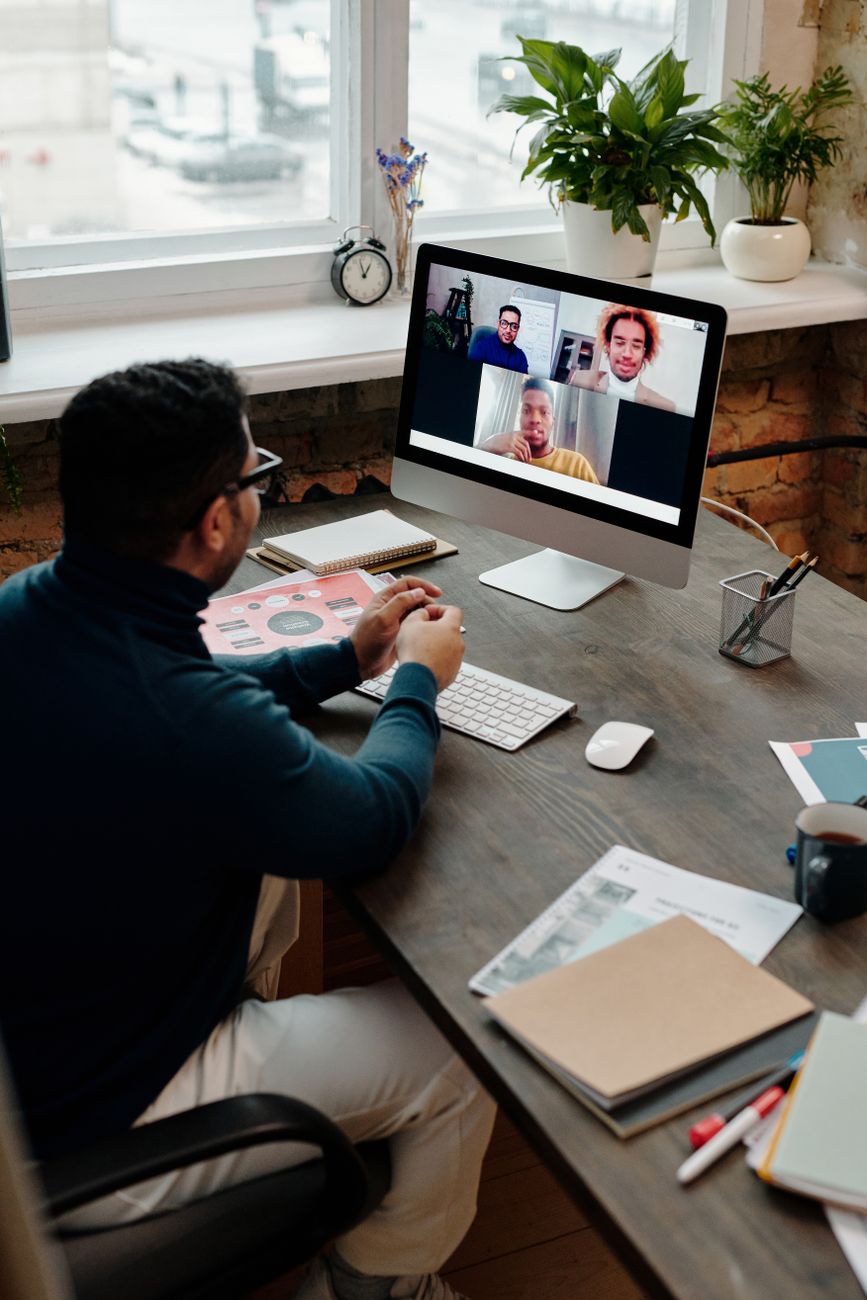
Six years ago, we discovered that almost everything could be a Teams meeting. The pandemic forced perhaps the fastest change in working culture any of us have experienced. Almost overnight, meetings, conferences, training sessions, interviews, catch-ups and conversations (and family gatherings) moved online. What might previously have required a train journey, a meeting room and half a day in the diary could suddenly happen with the click of a link. And remarkably, it worked, after some shaky starts.
There is plenty about that revolution that I would not want to lose. Online meetings save travelling time and money. They make it possible to bring people together from different parts of the country without asking everyone to sacrifice hours to the journey. They can be focused and efficient. They have improved access for many people and made participation possible where distance or other circumstances might previously have excluded them. Technology is increasingly doing the administrative hard work too, capturing transcripts, producing notes and helping us remember decisions and actions.
All of that is progress. But six years on, I wonder whether we are all becoming just a little tired of it.
Not necessarily tired of Teams, Zoom or the technology itself. I think we are becoming tired of a culture in which the online meeting has become the automatic answer to almost every need to communicate. And something seems to have changed in our behaviour.
We all know the signs. Cameras that remain resolutely switched off. The slight downward flicker of somebody’s eyes that tells you another email has arrived and is almost certainly being read. The unmistakable movement of someone typing while somebody else is talking. The occasional pause when a question is asked and everyone waits, wondering who will be brave enough to unmute, or whether they were listening at all.
Then there is perhaps the strangest development of all: the rise of the person who is technically at the meeting but is “just here to listen”. There is absolutely a place for listening. We probably need more of it. But listening is an active thing. It involves attention, curiosity, response and connection. There is a difference between listening and simply having a meeting running in the background while doing something else. If you’re chairing the meeting and seeking to generate rich discussion, a role I am frequently in, it can sometimes feel like trying to push water uphill.
We increasingly seem to have created a culture of being present without necessarily being present. I do not say that critically. I have done it too. An hour-long online meeting can appear in a busy diary and the temptation to answer a couple of emails at the same time is enormous. I admit I have sorted many expenses claims, rejigged diaries, and booked countless rain tickets myself.
We tell ourselves we can multitask. Perhaps we occasionally can. But I suspect that the more we normalise divided attention, the more we lose something important from the meeting itself. If multi-tasking becomes the norm, we are doomed to surface level engagement, and that’s not good.
Perhaps the problem is that online meetings have become almost too convenient. Before the pandemic, arranging a meeting required a little more thought. If six people were going to travel somewhere and give up several hours of their day, there needed to be a reasonably good reason for doing so. Now we can drop a 30-minute Teams meeting into six diaries with almost no friction at all. Too many people do that, and don’t leave gaps between meetings either. That ease can disguise its cost.
Six people attending an hour-long meeting is still six hours of people’s working lives. It does not become free simply because nobody had to get on a train. And there is another cost that is much harder to measure. Human beings do things when they are together that are difficult to replicate through a screen. We notice body language. We have the conversation before the meeting starts and the one that continues as we walk out of the room and along the corridor, or my favourite car park conversations. Someone says, “While I’ve got you…” and a problem is solved in five minutes. Someone else mentions something over coffee that was not on the agenda but turns out to be the most useful conversation of the day. Relationships develop in those spaces. Trust does too.
For those of us working in leadership, partnership and systems, that matters enormously. Collaboration depends upon more than exchanging information. It depends upon understanding people, developing relationships and creating enough trust to disagree, challenge, explore and think together. You can maintain a relationship online remarkably well. I am less convinced that you can always build one there. That’s why those with the purse strings and the timesheet police, need to recognise the enormous savings already achieved, and be more generous when the rare and important need to travel and be in the same space at the same time manifests.
None of this means turning the clock back to 2019. I certainly do not want a return to spending five hours travelling to attend a meeting that could perfectly well have been dealt with in 45 minutes online. That would be nostalgia rather than progress. However, I rather did enjoy my thinking time looking out of the train window.
Instead, perhaps the next evolution of hybrid working is about becoming much more intentional. Rather than asking, “Could this meeting be online?”, because the answer is nearly always yes, perhaps we should ask, “Would this meeting be better if we were together?”
If the purpose is to exchange information, provide a quick update, make a straightforward decision or bring geographically dispersed people together efficiently, online may be exactly right.
But if the purpose is to create something, wrestle with a difficult problem, develop a new relationship, rebuild trust, challenge assumptions, welcome somebody new, think strategically or simply reconnect as human beings, perhaps travelling to be in the same room is not an inefficiency at all. That is worth the investment.
Perhaps it is the work. There is something else we might need to relearn too: how to behave in meetings. Presence matters whether a meeting is physical or virtual. If we have decided that a conversation is important enough to put into everyone’s diary, surely it deserves our attention. Cameras do not always need to be on and there can be perfectly good reasons why they are not, but habitual invisibility changes a conversation. So does constant multitasking. So does joining a meeting with no expectation of contributing to it.
We should perhaps ask ourselves a slightly uncomfortable question: if I am only here to listen while simultaneously doing something else, do I actually need to be here at all? That might be the next great meeting efficiency. Fewer meetings. Shorter meetings. Better online meetings. And, paradoxically, more investment in the face-to-face meetings that really matter.
Because the lesson of the pandemic was that we can work differently. The lesson six years later should not be that everything therefore needs to happen through a screen. Technology has given us extraordinary flexibility. The challenge now is to use that flexibility intelligently. So I am going to make a conscious effort to spend a little more time in rooms with people. Not for every update, not for every catch-up and certainly not for meetings that could have been an email. But for the conversations where relationships, creativity, challenge and connection matter, I increasingly think the journey is worth making.
After six years of proving that we do not always need to be together, perhaps 2026 is a good moment to rediscover why sometimes we really do.