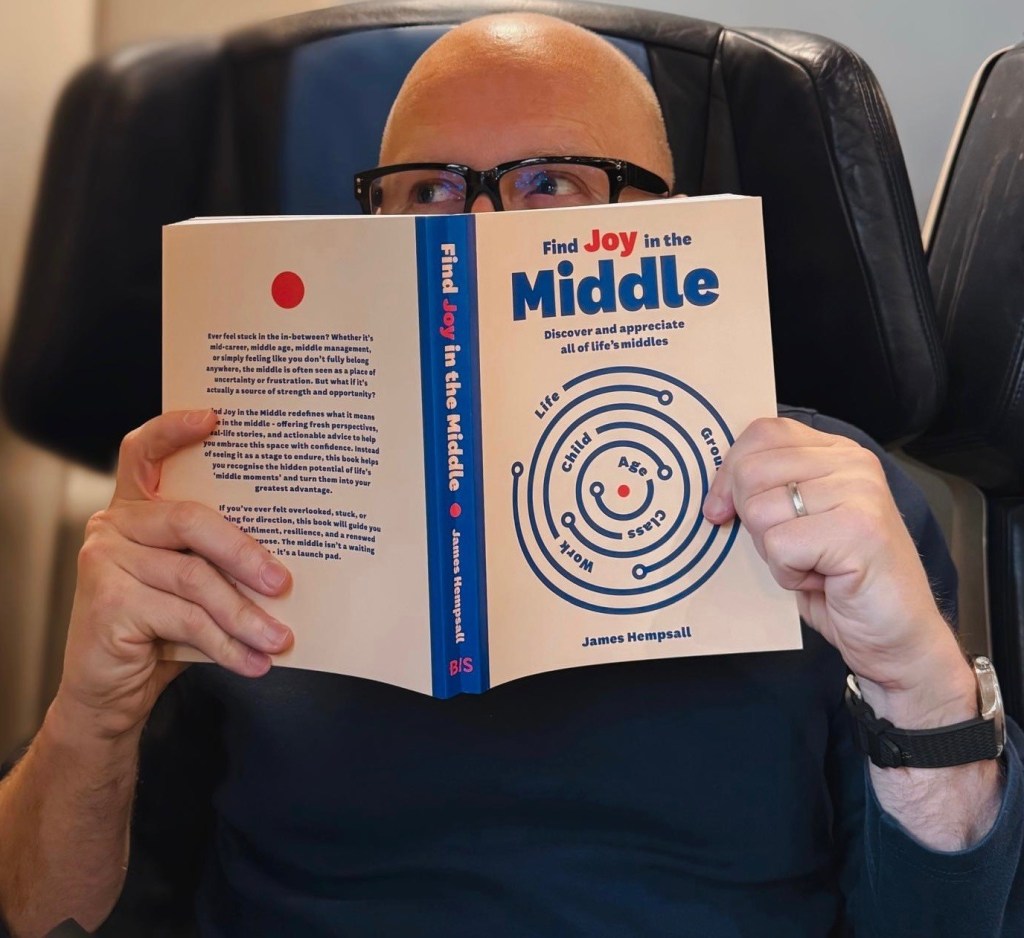
It’s been a year since my first book, Find Joy in the Middle hit the bookshelves. When I look back, I see a year that sat squarely in the middle, not just chronologically, but emotionally, socially, and culturally. It was a year that invited us to pause, to take stock, and to recognise the quiet power of being in‑between. In many ways, it felt like the world was catching up with what I’ve been saying for years: that the middle isn’t a place of stagnation, but a place of movement, momentum, and meaning.
For those of us in middle age, it was a year of reframing. I sensed a shift away from the tired old clichés of crisis and decline. Instead, people were beginning to see midlife as a pivot point, a moment to re-evaluate what matters, to shed what no longer fits, and to step into a more honest version of themselves. The conversations I encountered were full of people renegotiating their work, their relationships, their ambitions, and their wellbeing. It was as if the world had collectively exhaled and said, “right, what now?”
The middle class, too, found itself under the spotlight. Not always comfortably. There was a growing awareness of how squeezed and stretched this group had become, not wealthy enough to feel secure, not struggling enough to be prioritised. Yet this discomfort brought clarity. It forced a reckoning with what fairness means, what opportunity should look like, and how society depends on the very people it so often overlooks. The middle, once again, proved itself essential.
Even middle children, my favourite metaphor for the overlooked middle, found new resonance. Families were talking more openly about identity, birth order, and the subtle dynamics that shape us. I heard from many who felt seen for the first time, who recognised that their adaptability, diplomacy, and resilience weren’t accidents, but strengths forged in the in‑between. The middle child became a symbol of what I’ve always believed: that being neither first nor last can be a superpower.
Workplaces, too, were redefined by their middles. Middle managers, often dismissed or misunderstood, were the glue holding hybrid and flexible work together. They were the translators, the stabilisers, the human connectors in a year when organisations were still figuring out what ‘normal’ meant. I saw so many step into their roles with renewed confidence, realising that leadership from the middle is leadership in its most human form.
And then there was the middle ground, that fragile, precious space between extremes. I sensed a growing fatigue with polarisation. People were tired of shouting matches and binary choices. Others have been grasping onto their pre-extinction burst, fearful of change, angry with it and all perceived injustices, and they took to the streets to protest, or to create harm. Those in the middle ground were craving nuance, balance, and the courage to say, “It’s more complicated than that.” The middle ground, long dismissed as indecisive or dull, began to look like the only place where real progress could happen.
So yes, it has been a middle year. Not in the sense of being average or forgettable, but in the sense of being transitional, reflective, and quietly transformative. It was a year that reminded us that the middle is where life actually happens, where we grow, where we adapt, where we find our footing. And if we’re willing to embrace it, the middle can be the most joyful place of all.
I invite you to wonder how ‘middle’ your next year may be, and to think how you will be the architect of it.