Blog

‘Why don’t you’ just turn off your TV set?

I am of an age that remembers the children’s television programme ‘Why Don’t You?’ A programme that didn’t appear to understand the irony of their main proposition. That we should “just switch off our television set and go and do something less boring instead?”

It ran between 1973 and 1995. I admit I watched it in the seventies mainly. It is advice I didn’t really take on board back then, being an avid TV fan I enjoyed becoming lost in the screen. But it is certainly guidance I follow now. And that’s funny because I am not exactly a fan of guidance. Well, spoon-fed, rigid and unnecessarily detailed micro-management guidance I mean. Guidance that seems too plentiful, complex and fluid even for its authors or commissioners. Even they find difficulty in remembering or following it. I digress, a little.

We live in an information age.  A too much information era.  One full of rolling news, breaking news, hand-held computers, PCs, laptops, tablets, social media alerts and dialogues that bring out the worst in people more than it brings out the best. And now we are subject to Government information briefings.

Information and news should be giving us certainty and assurance.  Instead it appears doubtful and tilted towards the worst-case scenario.  Our attitudes towards and fears for risk and health and safety are being fuelled by endless speculation and polarised and mercurial opinions.  Even the science is hypothetical it seems.  Quite the oxymoron.  Yet we are told the news and guidance is based on the science.  What a contradiction.  Is this really what the concept of ‘fake news’ is all about?  Are we mired in the trap of conjecture instead of enjoying the freedom of fact?   

All of this seems to be driving up general levels of concern and feelings of uncertainty.  And this fuels anxiety levels.  And anxiety drives depression and that results in all sorts of unhelpful and unhealthy behaviours and mental health concerns. 

I am starting to think that ignorance is bliss.  That I should just switch off that television set (and device, ‘phone, computer and Twitter account).  I am looking at too much information throughout the day.  It’s the first thing I look at in the morning, and the last thing at night.  Sometimes during the night. 

COVID-19 has ramped up the volume of content, the urgency and importance of it, and its serious implications.  Like many I did look at the daily briefings at 6pm.  In full lockdown, we watched Jamie cooking on Channel 4, then switched over to BBC1 for the Number 10 briefing.  This lasted for a few weeks, then the content diminished (in culinary and information terms).  The same graphs were rolled out and the statistics shared.  It wasn’t news anymore.  Now, it seems, we are starting to watch again to spot the gaffs, contradictions, confusions, and the disconnections. I have to admit though I have been part of the content. I’ve done national and international television, local TV and radio, national and local press. Children’s TV clearly taught me a lot about irony!

I should adopt the same principle I have adopted with the weather forecast.  Don’t bother watching it. It is rarely accurate.  And it is best to take an umbrella anyway.  Just in case.

All this sameness is a big test

Now, I realise that I have been fortunate not to have been directly affected by COVID-19 in this past six months.  My family and friends have been lucky too.  Especially given so many of us are in the hotspot of Leicester.  I haven’t had to self-isolate or quarantine or shield.  But people around me have.  It has been hard on them.  The effects for me have been how life and work have been curtailed and how it feels, and I am reflecting on what it says about me. 

Its been 10 days since I have blogged. And I think the recent dearth of blogging has a lot to do with the sameness of life. Things have settled into small routines and not a lot of new in my life. I am fearful of what happens next – a full lockdown or the need to self-isolate and where that takes us all. In Leicester, the extended lockdown and the enforced separation from other households has been difficult. It has created tension and frustration as we all do our best to follow the often-uninterpretable rules.

The working week has settled into a rhythm.  Gone is the travel to London and back and elsewhere.  There are no more face-to-face meetings.  No clients arriving for meetings at the office.  No events, receptions, or training to deliver.  Instead, my place of work is the office a 10-minute walk from home.  My location is my desk – five days a week.  It was typically once or twice – if that.  And interaction is online in zoom and teams, seminars, training and meetings.  Thank goodness two colleagues are able to come in and we can work at a safe distance from one another.

Evenings are spent almost exclusively at home without visitors.  Weekends tread the familiar path of exercise, shopping and cooking.  It is these changes to personal and professional habits that are a real challenge.  There’s no more theatre, cinema, cafés, or pleasurable meandering shopping.  Instead, its boxsets and TV, eating and drinking at home, and purposeful mask-wearing shopping.  I do feel like a ninja in the supermarket.  Masked up and focused on my smash and grab buying.  Not much to complain about then I hear you say.  I agree. 

But it interesting what it does to one’s mood and how motivation ebbs and flows and impacts on mental health.  Where is all that emotional benefit from the activities of the previous way of life?  It is funny how being busy or at least moving around a lot filled the day before.  It can give a sense of purpose – whether that be real of false.  Perhaps it is a distraction.  But I miss it.

I have found writing a great comfort and occupation over the past six months – blogs, work projects, and even two books on the go.  But that has waned for the time being.  Creativity has diverted towards hedgerow harvesting and preserving.  The many jars of sloe gin and plum chutney amongst other things are a testament to that.  What happens next is anyone’s guess.  The prospect of a further six months is something to tackle head on and learn from. 

I’m proud of the word childcare.

Recently I listened to a practitioner complaining about being described as a childcare worker.  It didn’t seem enough to them.  What a shame I thought.  My entry into the sector was in childcare, out of school actually, for 5-12 year olds.  My practice soon extended to pre-school groups and children’s centre management.  I was thrilled to see a bringing together of childcare and pre-school learning in 1998 when the national childcare strategy stimulated local early years development and childcare partnerships (EYDCPs).  There was a huge push for new out of school childcare to be opened up, but it wasn’t long before I noticed the emphasis swing towards pre-school learning. 

Much has changed since, and alas EYDCPs are long gone.  However, it seems somethings haven’t changed, and one of these is the artificial and unnecessary boundaries we create and maintain in our sector.  National policy has placed a wonderful emphasis on early learning in recent years – for multiple and differentiated outcomes, some for learning, some for childcare, some for closing the attainment gap.  The things is we all do that across all aspects of the sector, regardless of the fashion and the funding, national policy or income stream attached.  We would be so much stronger if we focused on this as a whole package of outcomes and on what brings us together rather than what sets us apart. 

Like many in the sector, I place equal value on the terms childcare and early years.  And I think this is something parents do too.  To suggest equality in them shouldn’t diminish either side of the bargain.  Instead this should bring them and us all in the sector closer together in the intended spirit of the profession. 

Children attend provision and families rely upon it to meet a range of needs, social, educationally and economically.  It is a great privilege to be chosen and trusted by a family to look after, to care for, their child.  And to become a partner in their learning journeys either before school, during school, afterwards or in the holidays is an invaluable and rewarding role.  To know that we are playing our part to help children and their families achieve outcomes like safety, health, enjoyment and achievement, economic choices, and making a positive contribution to society (Every Child Matters) must focus our minds on the inputs we design and deliver as a whole team.  Supporting families, and women in particular, to play an active role in the workplace is proven to be good for the whole family.  It has the power to help break achievement and progression barriers, develop economic resilience and capacity, and impact on the ambition and opportunity for future generations to come.  

The early years and childcare sector needs to be one sector, not a collection of sub-sectors.  We must start talking in one voice about what we can do for society, learning and the economy. Our focus should be on what brings us together and not on what could tear us apart.  Then we will all get the chance to deliver together what every child and family needs and deserves by leading the debate as one movement. A  movement that everyone will understand, value and follow. 

Photo by Magda Ehlers on Pexels.com

What can we borrow from new trends in retail?

We are all considering the changes to our work and personal lives prompted by COVID-19.  Lots of businesses and customer behaviours have shifted.  We all should watch and consider these and respond to them in the short- to long-terms.  The important questions are, how many of the changes will stay around forever and which ones will revert to the old ways? 

Timing is everything.  The most successful businesses will be the ones that are nimble and quick to spot a need and meet it.  These considerations are key to all our forward planning and require us all to keep a weather eye on the external environment and to read trends now and trends next.  We need to confidently embrace our powers of estimation and prediction to inform good risk taking and business innovation. 

Of course, the developments in early years and childcare have occupied us all since March 2020.  The changes to actual use, types and sizes and locations of setting, hours needed, and patterns affecting eligibility for two-year-old funding and for 30 hours.  Recently, I have also been looking at retail trends, and part of me was thinking how these may be reflected in the early years and childcare world.  What are the similarities and what can we in early years and childcare learn from them?  It might seem tenuous, but read on…

There’s been an increase in online shopping.  Some say use of such technology has leaped forward as much as 10 years.  As a result, people expect much more of your website and online presence.  Clearly you cannot deliver or use childcare online, but you can certainly find it, pre-select and connect with it.  People are travelling around less than before and are focused on the tasks at hand when they are out and about.  So online is hugely important in how we reach, inform, connect and communicate with families.  Make sure all your content is where it should be, so people can find you, for example national websites and local FIS directories.  You need a constantly updated website that functions perfectly on mobile phones. We all need a new online strategy.

People want to support local businesses.  In times of crisis or trauma there is an enhanced need for a sense of togetherness.  Think ‘blitz-spirit’.  Customers are seeking out real people, running local, independently owned businesses – this could be you.  The relationships are becoming more discerning and interpersonal, searching for personalised customer service, and the social aspect of shopping and using.  There are opportunities here for childminders and smaller local settings, and the larger and even chain settings need to reconsider their local credentials.  Get your local message across. 

Instead of slow delivery services, people are liking the idea of curb side pickups.  The link here is more tenuous, but there is one.  We have all seen how drop-offs and picks-ups have been rethought for safety reasons at the nursery gate or childminder’s doorstep.  These new interactions are about convenience, new routines and parental preferences.  Let’s prioritise responsiveness, flexibility and change. And balance these new arrangements with other ideas to support other ways to engage and welcome.

Retail is growing its local delivery offer.  This trend is about real people providing the real personalised and flexible services, not relying upon generic solutions or delivery service providers.  For early years and childcare this is an opportunity to build on our strength of real interpersonal connections and to individualise delivery.  If you are the business owner and you are usually in the office, now is the time to be visible, to connect and to be more present.  For other team members this is an invitation to be authentic people. 

The fifth and final trend is virtual experiences.  We have all entered a much bigger online world that we had before.  Here, we should embrace the functionality of technology to hold meetings and training, manage initial enquiries, have discussions, offer setting show-arounds, and provide setting inductions and tours.  Social media needs to be current, accurate and regularly updated and can promote all the messages described in this blog.   

None of these ideas seem too farfetched to me.  And we should all look beyond the obvious changes and listen to the values and feelings that demonstrate the need for all of us to offer real connections and social value to our work now and in a sustainable future. 

Photo by Oleg Magni on Pexels.com

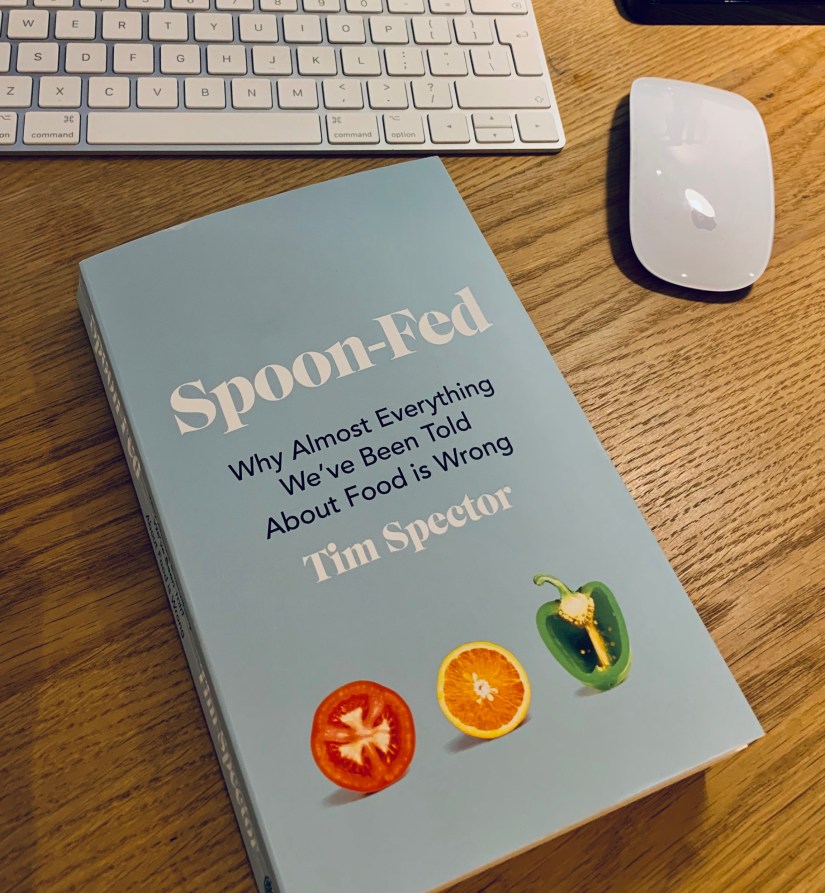
This week I read ‘Spoon-Fed: Why almost everything we’ve been told about food is wrong’ by Tim Spector.

I’ve always loved food and been interested in it. And I relish a conspiracy theory, so this book seemed like the perfect combination to me. A critical look at what we’ve been told, and an open determination to debunk food myths, whilst setting out an informed food direction. I was hoping for some affirmation or new ideas. I got both. These were my personal take-aways (pun intended):

  1. Food is big business and controlled by a group of global Goliaths who fund science, PR and sophisticated marketing that seeks to manipulate the way we view food, buy it and eat it. They generate, pounce on and exploit our interest in food choices and needs.
  2. Don’t swallow the science. Food research tends to be biased and looks at things in artificial isolation. The results are most often small percentage changes, benefits or risks. I mean, doubling a risk of something when the risk is only 1 in 100,000 isn’t enough for me. Risk needs a huge side-dish of perspective.
  3. Enjoy real food and take pleasure from it, it is an investment in self. Detach from the notions of it causing death or early mortality, illness or self-harm. “If we start to believe food will make us ill, the chances are it will”.
  4. Consume food, coffee and alcohol in moderation. Move away from any sense of guilt, shame or indulgence, and retune to focus on investment and self care instead.
  5. Focus on yourself as an individual and what food does to your body. Set your own rules and regime based upon listening to yourself. Develop your sense of food-self, respecting your metabolism and mental health. Connect your emotional wellbeing and mood with your gut feelings. Literally.
  6. Adopt a Goldilocks principle – not too much, not too little, just the right amount. The Goldilocks principle is that something that falls within certain margins, it does not reach extremes. That way we can enjoy the ‘yes’ and some of the ‘no’ foods in balance.
  7. Include in your diet things like natural unsweetened yoghurt, butter (not low-fat spread), good eggs, oily fish, grass fed meat, game and wild meats, mushrooms, sugar not sweetener, beans and pulses, and natural probiotics. And salt, as long as it is consciously consumed – it improves taste, and a tasteless life is a wasted life, I say.
  8. Don’t let ultra-processed food producers determine how much you eat and do your calorie counting for you. Convenience food is inconvenient to health and wellbeing. It buys you time in the short-term but costs so much more in other ways. There’s a huge difference in the range from unprocessed foods through to ultra-processed foods. The latter being the one to avoid. Ultra-processed foods have labels and labels lie or at least bend the truth and mislead us, they skew the message and use percentages that are not clear to most of us.
  9. Calorie counting is an imperfect and inaccurate science and must only be used as a rough guide. It is better to focus on conscious consumption. With proposals for restaurants to publish calorie totals in government thinking, Spector says they systematically underestimate them – making an imperfect science even less reliable, I think.
  10. Breakfast is as important as any meal. And any meal can be skipped occasionally. It won’t hurt. Fasting is something thought to be beneficial. It’s okay to feel hungry once in a while. But skipping a meal should never be justification for bingeing at the next mealtime – this isn’t about offsetting. Just like exercising is not a license to run straight over to the vending machine afterwards.
  11. Don’t take vitamins or supplements unless you are not well and been advised to. I had started to wonder if I was developing IBS last year. Then I stopped taking daily vitamins. Problem solved. So I agree with this idea. And 15 minutes in the sun will be sufficient to top up vitamin D – which isn’t a vitamin, I discovered, it’s a steroid hormone. “Let food be thy medicine and medicine be they food” said Hippocrates.
  12. Avoid the superfood trap. Other cheaper or local alternatives exist, for example, strawberries are a good alternative to goji berries. Again, eat consciously and in moderation.
  13. Think about the ‘buy local’ benefits and disadvantages. I learned local isn’t always the best option when considering environmental impact. For example, tomatoes grown in the natural heat and sunshine of Spain and imported, are said to be better than ones grown in heated polytunnels in England. There is a moral obligation also to the developed world’s continued and fair trade with developing countries.
  14. Water. Who knew that water would be such a confusing and tricky subject? I concluded filtered tap water to be the most ethical. And bottled spring and mineral water, locally produced and sourced to be a good alternative – or treat even. Preferably in a reused glass bottle, avoiding single-use plastic as much as possible.
  15. ‘-Isms’. It seems to me that lots of energy is focused on puritanical and quasi-religious approaches to food and diet. We don’t need to put ourselves into rigidly defined boxes. Be a flexitarian not a follower of rigid rules or definitions.
  16. Fish isn’t as good as we think it is. Some is unsustainable, other is intensively farmed. Again, don’t listen to all those corporate messages linking it to longevity and cognitive functioning. Best keep it, like good quality meat, as more of a weekly treat. Be open to trying a wide variety, move away from the standard cod, salmon and bass. And derive similar nutritional benefits through seeds, nuts and algae instead.
  17. The information about chemical use made me want to grow more of my own food. And whilst I acknowledge intensive farming is seemingly necessary to feed our huge global population, and that organic is a privilege of those who can access it, I want to make more organic choices in my diet.
  18. Overall, Spector has confirmed my resolve to make good quality choices with variety and diversity. To eat good simple meals cooked from scratch, using natural seasonal ingredients, and embracing more fruit and vegetables. Controlling portion size is important. As is knowing where my food is from. Making better friends with my freezer. And always understanding what my food is and how it is made.