I am a business leader, psychotherapist and equalities and social policy consultant. An enthusiastic advocate of working and living well, I believe in supporting everyone to have positive, safe, and equal chances within a modern environment.
I've worked in the field of early years learning, childcare, anti-discrimination and equalities for over 30 years. For 25 of those I have managed my own consultancy and training business www.hempsalls.com working nationally and internationally for a range of government, charitable and private organisations. Throughout that time I have loved shaping and delivering policy, and working to useful, impactful, and outcome focused solutions. And with a nod to my original passion for design, I am also a co-director of www.harrimanandco.com an independent furniture and home-ware design store.
It was a working at home day yesterday. You know the score, deliveries expected, some maintenance happening in the garden and a key document needing writing with a clear head and no distractions. That was the plan, anyway. Don’t really know how I managed to fit work in at all.
The rollercoaster of COVID-19 challenge and change is a familiar tale. And things have been getting me down recently. It’s fatigue I think, the effects of adrenaline and determination have waned somewhat. They aren’t far away. And I understand they aren’t a constant, they are dynamics that ebb and flow organically.
People have noticed.
So, imagine my surprise and delight to receive a delivery of goodies, from a dear friend, a ‘local lockdown survival kit’ I was advised. A reward for the hard work and for surviving the trials and tribulations of recent months. Very gratefully received I have to say. I was over the moon.
Then, a letter from a building society. Dull one would expect. Oh no, an admin error and an over-payment of a professional fee. A refund due, with interest. £500. Thank you kindly!
Fast forward to early evening. The local florist at the door. A bouquet of flowers from the in-laws. Something to cheer you up, you seemed a little down at the weekend!
What a day. It felt like the universe had shifted in my favour. To some degree. I was thankful.
We all know the importance of celebrating mini-victories and valuing what we have during COVID-19. I must admit the extended local lockdown has been traumatic and difficult on top of something that was already tough for three months prior to that. We’re not through it yet. But yesterday did feel like the beginning of a little bounce back. I attached myself to the positive feelings of hope. Thank you to those that made that happen.
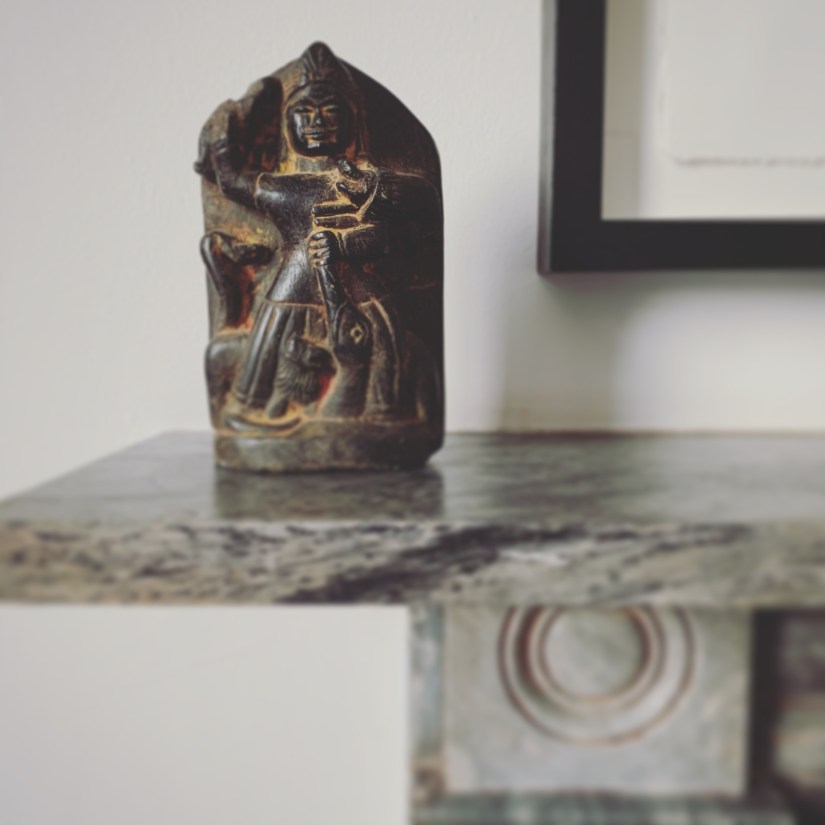
This morning, something happened that rocked my confidence. I knocked over Bhimsen. Who, you may ask? Bhimsen is considered in Nepal to be the god of trade and business. It is also believed he has superhuman strength. I have a Bhimsen made of stone sitting on my bedside table. Sometimes you feel like you need all the luck you can muster. It felt like a heart-in-the-mouth moment. But fear not, he was still intact. Best put him on the mantlepiece so he is safer, I thought. I did. And he is fine.
Later, when walking to work, a white feather descended from the sky in front of me, then encircled my head and shoulders, returning to float in front of my face. What a comfort that was. The sign of angelic energy.
It made me think about the power of symbolism, the need for resilience and the comfort that all sorts of signs offer us and how they help us through times of difficulty. I ended the day having been told this afternoon’s two business proposals have been agreed and accepted. Thank goodness some things are going well.
I’ve noticed better relationships between local authority early years teams and childcare providers as a result of the impact of COVID-19. Every week, and increasingly so, LAs and providers are telling me that effective partnership working is making a real difference in finding a way through the current challenges and getting as ready as possible for a difficult future ahead. We do need to work together better, and so if this is not the case in your area, what can you do about it?
For the past four months, I have spent a good proportion of each working week on screen in front of local authority early years teams and leaders, and early years providers and practitioners. We have all been working out ways in which we can carry on with our vital services and together plan for an uncertain future ahead.
Time and again I see wonderful interactions and sharing of information with the common purpose of meeting the needs of children and families. Long may this continue. We have always needed to work in partnership. The challenges of change, economics and new entitlements have required us to do just that over recent years. At a time when the type and level of support LAs are able to offer has changed as well. But just when we thought we had had a rough ride through 30 hours, and with Brexit ahead of us, the coronavirus has topped the lot when it comes to significant challenge. Brokerage of places for children that need them and workforce support are both good reasons to collaborate.
The things I hear about include great interpersonal relationships and professional friendships arising from regular verbal contact. Much of which was prompted by the need for weekly calls and contacts to collect data for DfE. Government has turned its attention and concern to opening, closures and place capacity and use. But more has been happening in these contacts. Information, experiences and emotions are shared of lived experiences through this crisis. We are a caring profession and there has been informal counselling, certainly listening, the sharing of emotions and the acknowledgement of them. The pendulum has swung helpfully away from a reliance only on email and portal communications. It is resource heavy and DfE has asked this continues to the end of September 2020 at least.
The provider and the practitioner experience should and must be a voice heard in any early years and childcare strategy. And not just the loudest, more confident or biggest ones. These contacts, and others, I think are allowing the other voices to be heard and included and considered. I am told topics that were never talked about before are being readily discussed in a spirit of openness and honesty. To some extent video conferencing, now people are getting used to it, has made this more accessible.
There is a negative side though. These trials and tribulations do prompt anger and frustration and often this can manifest in attacks and criticism. It is understandable, but it is regrettable. Everyone needs to remember we are all doing whatever we can, to our best ability, and we all want the same outcomes in the end. There are people at each end of communications.
Returning to the positives, many more council leaders and decision-makers are realising the true and indispensable value of early years and childcare as part of their learning, social, equalities and economic strategies. We are a partner and a key stakeholder in this and local recovery.
I hear how local childcare sufficiency assessments (CSAs) are collecting much higher rates of provider returns. Response rates to surveys about supply, demand, need and parental preferences are usefully healthier than of late. These assessments are not only a statutory role of the LA, they are essential when they are used to drive and inform local childcare market management strategies. Again, a statutory role of LAs in The Childcare Act (2016). Never has there been a greater need for such research, strategy and market support and direction.
The dynamic range of change of use of our provision will be enormous as families’ circumstances are affected by the fall-out of this pandemic. Eligibility for the two-year-old entitlement my increase hugely as unemployment rises and Universal Credit claims increase. 30 hours eligibility may fall, stay the same, or increase as parents’ employability changes in a multitude of ways. Universal 15 hours may remain constant, but what about the demand for it as parents decide how and where they work or access services? How will parents’ and providers’ views on single-use settings affect demand and supply? And the paid-for childcare market, already changed by 30-hours could take a while to recover to anything near what it used to be.
Our relationships will be the vital ingredient in what happens next. Solutions exist in the sector and will need to be further developed, change identified and created together.
We all sat in front of our screens in Leicester yesterday evening. Hanging on every word uttered by Matt Hancock in the House of Commons. We were not eagerly expecting good news. There was more of a sense of silent dread. The city has been an unusually gloomy place since our lockdown was extended for two weeks. We’re not normally like that.
The reality of our local lockdown is restricted travel in and out of the city (there are Police checkpoints), schools and early years settings are only working with children of keyworkers and vulnerable children, non-essential shops, cafes, bars, restaurants and hairdressers all closed.
The whys and wherefores have been well-scrutinised locally, politically and in the press. They continue to be. There are various theories as to why Leicester was chosen to be locally locked down. Questions remain around what and whose data informed the decision? What social conditions drove a spike in cases? How local is local? What was the reasoning around the geographical boundary drawing? How can the effects of increased testing skew data? And who made the decisions, when and how? I won’t get into any of that. Fascinating as it is. It is just too depressing to live with. The fact remains that for another fortnight we are locked down in Leicester.
I confess it was very annoying to read the press and several congratulatory texts received last night that considered this lockdown to be an ‘easing’. It isn’t much. I live and work right in the centre of the city. Both of my businesses are in the city centre, one of them a shop. And Hancock’s announcement meant nothing will change for me, my household, and those businesses. What has changed, is the city exclusion zone boundary has been redrawn, in favour of neighbouring towns in the county, and local decision-makers have powers over non-essential shops’ opening or closures (what that means remains to be seen), and schools and early years settings can reopen fully from 24 July 2020. A curious offer to schools to reopen in the midst of the summer holidays I have to say. That said, schools must do more to complement local childcare provision and enable it to continue.
It still means that people are discouraged to enter or leave the city for anything other than essential journeys. This is staggeringly destructive for a city like Leicester. You see, Leicestershire and Leicester is like a doughnut. The relatively affluent county of Leicestershire surrounds the ‘hole’ in the middle, Leicester, one of the most impoverished cities you will find. I’m not saying Leicester is a hole, I love the city, but you get my point. Without county folk coming to work, shop or use services, the city is a very different place. The demand for childcare, for shopping, for anything is curtailed significantly. And these effects will be long lasting as people come to view Leicester as a special case, perhaps less safe than elsewhere.
Early years and childcare providers in Leicester are inevitably struggling to manage these changing conditions. Like everywhere else, there was a growing sense of optimism and confidence in childcare use from 1 June 2020. Now we are stuck in reverse gear. Suspended as it were in aspic. With people working from home, the summer holidays, swathes of businesses remaining closed, no migration into the city and these controls over how the population can move and behave, current and likely future demand is very low.
The local authority team, who I know well, reported in one of our online regional networks this month, their response team was in regular contact with providers, information was being shared, risks were being identified. They have been consulting settings, ensuring government funding support is being accessed, and sufficiency is managed. Grant funding has been made available for those who fell between the cracks of the national funding schemes. A package of great support. They also reported parental confidence in returning to using provision is low. Numbers using also remains low.
I would urge any local authority to consider what characteristics they share, or parts of their area shares with Leicester. There could be a need for targeted and differentiated support for providers in those areas. Especially with PPE and safe practices. In Leicester, many children were found to be COVID-19 positive, and whilst they were asymptomatic or had mild symptoms, they were going home to cramped housing and multi-generational families, often with vulnerable relatives. This is a key element of risk assessment. In terms of business support and provider sustainability there will be huge need to change and adapt. Our Finding Your Way Through programme helps with this. The sector will experience highly dynamic change of need, demand and preferences, of parents and practitioners and providers. LAs need to be front and centre by market managing this change.
It’s an obvious and easy call to ask for more government funds, but Leicester, already economically deprived enough, is at a further disadvantage by having to endure at least four more weeks of lockdown, and the ripple effects caused by the stigma attached. Two reasons why more could and should be done to help business such as early years and childcare to better weather this storm. Lockdown could go on for weeks or months to come. And there is always the risk of a second wave of COVID-19 in the autumn and winter. The whole sector needs investment, not just in Leicester, to protect it, develop it, change it and help families, businesses and the economy to recover in turn.
Leicester’s National Space Centre. Taken on last weekend’s walk.
For all of us, there is one key question. Do we opt for pleasure now, or delay it for later? The concept of waiting for gratification has been under attack for some time. The motor car, the jet plane, the television, the microwave oven, the internet and now multiple and instant access TV streaming channels, and food delivery apps have all been step-changes in upping the pace of it.
You want something? You can have it now. You don’t have to wait until 7.30pm to watch your favourite soap. A few clicks and it is playing live whenever and wherever you want. You don’t have to wait until next week to watch the next episode. Watch it now. In fact, download and gorge on the whole series in a single day if you want to. If you need information it is in your hand within seconds. You don’t have to go to a café or shop for food, it can come to you via bike courier within 20 minutes. Our tolerance for delay, our ability to be patient, to put in effort to gain rewards are all qualities being systematically eroded.
The ‘now’ culture, the ‘get famous quick’ society tells us to live in the moment, capture it on our ‘phone cameras and publish it for all to see. It asks why wait? This time tomorrow you could be globally trending. We subscribe to all sorts of adages, things like ‘you only live once’. Time, we are told is running out, insufficient even for all the things we are being told we want to do. The result is we make deliberate efforts to pack things into our days like an overstuffed suitcase.
The technological facilitation of instant gratification has waged war on any sense of delayed pleasure. It is a high-tech industrial lifestyle revolution. This goes a long way to diminishing any sense of purposefully and diligently working hard and with intent to an identified goal.
With lockdown, we have no choice but to wait. So many things are delayed. Where is the pleasure anymore? When will gratification occur? In Leicester, it feels like we are suspended in aspic. Stuck in time, patiently waiting for lockdown to be relaxed so we are like everywhere else in the world.
For some time I have been talking about how I thought society has been subconsciously preparing for harder times to come. We have been bingeing on stuff and food because we knew on one level different painful times were ahead. The id, as Freud would put it, our basic selves, is driven by the ‘pleasure principle’ that seeks out pleasure so we avoid the pain. And the pain people are trying to avoid is this cumulative sense of our demise, personally, as a community, a culture, a nation, a global species. We are given constant messages about the challenges experienced in the natural world; habit destruction, species extinction, and population migration (animal and human). Human population growth is so out of control we realise that one day the good times will end and rationing and restrictions of all resources will be put in place. Our young people are so anxious about it their mental health difficulties and anxiety levels are through the roof.
So humanity’s response, typically, has been ‘let’s feast now before famine follows’. Its like a bountiful summer and autumn before a hard winter ahead. We feel we shouldn’t delay gratification, because it simply might not be possible in the future. Whenever that is. And we all hold different constructs of what the future is. For some it feels like a distant concept, for others it is an all too brief prospect. Little did I realise the forces of such limits would manifest so soon and so profoundly with the COVID-19 pandemic of 2020.
So why wouldn’t everyone reach out for pleasure? Why feel guilty or judgemental about it? Pleasure is an escape from reality, it is a diversion, and getaway. It’s so dreamily tempting. Surely we all need that? The trouble is, it doesn’t really help any sense of long-term planning for the future. Its childlike, not ‘adultlike’. When we are young, we operate through the pleasure principle and expect immediate fulfilment. Then it’s all about basic needs, milk, food and comfort. We expect the breast, and protest when it is withdrawn (Klein). Later on in life it is still about our basic food and drink needs, with the addition of sex and the procreation urge. Something that has fed into a global population growth pandemic.
But as time marches on, we learn that we need to wait for gratification. It’s how we build resilience. And lockdown has forced our hand in direct and obvious contrast to our pre-pandemic lust for the instant and convenient. It has truly upped the ante. Much is said about the negative effects of the pandemic. There are potential benefits to reap. Many say delayed gratification is one of the most effective attributes of successful people and their jobs, lives, physical and mental health. But how long do we have to wait? Because we just weren’t used to waiting anymore. Until now.
Since March 2020, any sense of long-term strategy has flown out of the window. It can sometimes feel like an achievement to survive the next hour, the whole day, or make it to Friday (should you still know what day it is).
Working from home, reduced teams, and socially distant office spaces all contribute to feelings of loneliness and isolation. There are positives. We have a plan, it is the right one, and it is working – slowly. On the plus side new relationships have formed, or existing ones have become closer and stronger – even allowing for the medium of on-screen dialogue. So, what have I reminded myself of today?
Have intent. First, it is important to be steadfastly objective. Define the goal or goals along the way. Goal setting shouldn’t be done alone nor without talking and listening to those around you. It is a process informed by horizon scanning, a good realistic look at what is possible, or not. And be prepared to revisit goals and change them. Make time to celebrate when goals are achieved before heading for the next one(s).
Own it. In times of crisis and change, teams and organisations need leaders. They need leaders who are objective, bring everyone with them, keep up their own motivation and that of others, and make the decisions people need, want and respect. However hard, and emotional and difficult they are. Now is the time to make decisions for the longer-term. Whatever that may look like. No one knows what will happen next of course, but you need to be fighting-fit for any scenario including the worst case one.
Connect. You cannot do this alone, so you need to be bringing everyone with you. Talk and listen with (not to) everyone in the team, those in the supplier chain, and customers. Discuss and explore what is possible and what is not. By doing that, your decisions will be better informed. They might not always be the right ones, but they will be ones that you and everyone understands and has a committed stake in. Here you gain support. And keep communicating, keep sharing and talk about how things are going. This will help identify things that need rethinking.
Keep it up. Motivation that is. Easier said than done. Some days this will not be a problem at all. On others you will feel like you are running on empty. It helps I think to have your clear objectives, a team around you and to deploy your leadership behaviours. Vision and goals allow you to look beyond daily challenges, but a realistic and achievable to do list for today is a great way of generating a sense of achievement. That helps my motivation anyway. Useful principles here are to focus on what is achievable and making sure you have a balance of what needs to be done, and what you like to do.
Decide. Be able and prepared to make decisions quickly and now, and in the medium and longer terms. Retain or grow the ability to change decisions based on evidence and your analysis. Never decide on anything by evidence alone! We need to examine, consider, and apply our business acumen to all decisions. Be willing to take risks and be prepared for some of them to work. And own them. And be accountable to them to the team and to customers. Keep talking, continue listening and your intent will benefit from it. Then repeat.




 Find Joy in the Middle